Systaems

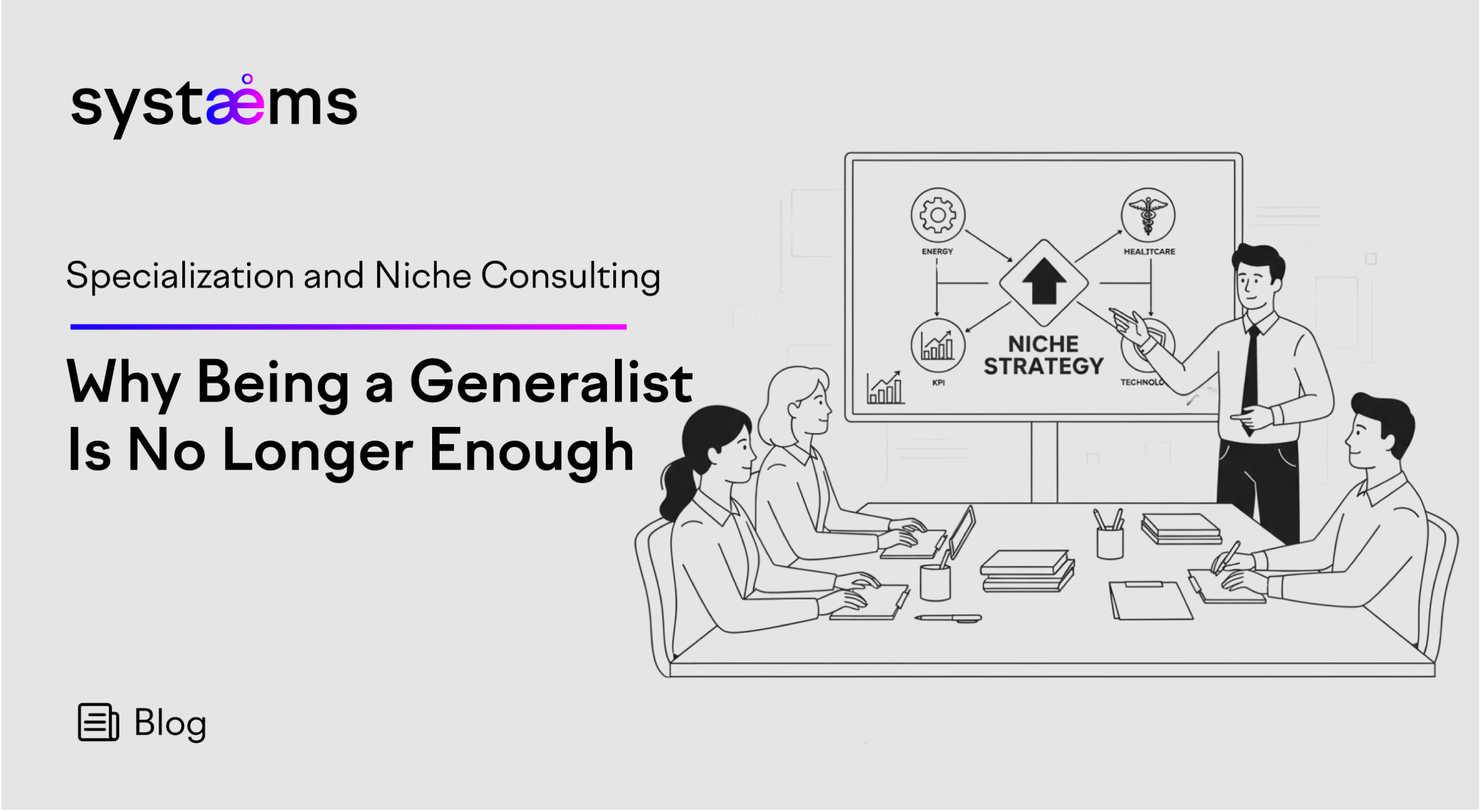
Specialization and Niche Consulting: Why Being a Generalist Is No Longer Enough

Validated by:
Written by: Kavya RS
Published on: 22 April, 2026

On this page

    Why Specialized and Niche Consulting Is Outperforming Generalist Models

    For decades, consulting success was defined by versatility. Large, generalist firms built their reputation on offering broad strategic guidance that could apply across industries. Yet in today’s business landscape, breadth alone is no longer a competitive advantage. Organizations now seek consulting partners who combine strategic insight with deep functional and industry expertise. Clients are asking more precise questions, demanding data-backed insights, and expecting solutions that go beyond frameworks to deliver measurable transformation. This paradigm shift has given rise to specialization and niche consulting – a model where expertise, not scale, drives impact. At Systaems, we have seen this shift firsthand. Our specialization in Performance Management, Data Services, and Governance Systems enables clients to bridge the gap between strategy and execution, ensuring every engagement drives measurable business outcomes.

    Summary

    • Generalist consulting is losing relevance as clients demand deep functional and industry expertise.
    • Niche consulting delivers measurable outcomes through sector-specific knowledge and proven playbooks.
    • Benefits of specialization include more profound expertise, greater client trust, premium pricing, faster results, and sustainable differentiation.
    • Case study: Felda Global Ventures (FGV) shows how specialized performance management improved efficiency, reporting, and strategic alignment.
    • Firms can build niche strategies by identifying core strengths, leveraging case studies, investing in industry knowledge, developing proprietary tools, and aligning messaging.
    • Technology (AI, data visualization, customized dashboards) amplifies the value of specialized consulting.
    • Balancing specialization with a portfolio of niche practices ensures agility and credibility in a competitive market

    Why Generalist Consulting Models Are Declining

    While generalist consulting still plays a role in large-scale transformations, it is increasingly challenged by structural and market realities:

    • Intense competition: The market is saturated with consulting firms offering similar generic frameworks, making differentiation difficult
    • Lack of depth: Broad methodologies often fail to address the nuances of specific sectors such as energy, healthcare, or fintech.
    • Evolving client expectations: Boards and regulators now prioritize consultants who can demonstrate proven expertise and measurable outcomes.
    • Technological acceleration:  With AI, analytics, and automation transforming industries, firms need consultants who understand not only the tools but also the industry context in which they are applied.

    In this environment, generalist firms risk commoditization. Clients no longer buy methodologies; they buy mastery.

    The Rise of Niche Consulting

    Niche consulting firms are emerging as trusted partners for organizations seeking sector-specific expertise. These firms focus on specialized domains such as:

    • Regulatory compliance for financial institutions
    • Sustainability and ESG for manufacturing and energy companies
    • AI governance and data ethics for technology-driven enterprises
    • Healthcare operations and performance optimization for hospitals and research organizations

    Such consultants do not simply advise; they bring proven playbooks, contextual insight, and technical fluency that enable clients to achieve outcomes faster and with greater confidence.

    A related discussion of the evolving dynamics of outcome-based consulting can be found in our blog, “Outcome-Based Pricing & Contract Models in Consulting,” which examines how performance accountability is reshaping client-consultant relationships.

    Benefits of Specialization

    1. Deeper Expertise

    Specialist consultants possess an intimate understanding of industry dynamics, competitive pressures, and regulatory environments. This knowledge allows them to design solutions that are not only strategic but also executable within the client’s specific operational realities.

    2. Higher Client Trust

    Clients are more likely to engage with firms that have demonstrated impact within their sector. Trust is built on proven relevance, not theoretical frameworks.

    3. Premium Pricing and Value Perception

    Specialized consulting commands higher pricing because the perceived value is linked to scarce expertise and measurable outcomes rather than the number of hours billed.

    4. Accelerated Results

    Leveraging prior experience and industry benchmarks, niche consultants deliver results faster by eliminating the learning curve often associated with generalist approaches.

    5. Sustainable Differentiation

    In an increasingly competitive marketplace, specialization enables firms to differentiate themselves through unique intellectual property, sectoral depth, and trusted relationships.

    Case Insights: Felda Global Ventures (FGV)

    A powerful example of specialization in action comes from Felda Global Ventures Plantations (FGV), one of the largest plantation groups in Southeast Asia.

    FGV partnered with Systaems to design and implement a Performance Management System tailored to the plantation sector. The system integrated financial, operational, and sustainability KPIs, enabling leadership to make data-driven decisions that improved both efficiency and accountability.

    The results were measurable and transformative. FGV reported a significant reduction in reporting lag, enhanced visibility across its value chain, and greater alignment between operational performance and strategic goals.

    This case illustrates the power of specialization. A generic consulting approach would not have captured the unique productivity cycles, environmental variables, and regulatory frameworks specific to the agricultural industry. Specialized knowledge enabled a solution rooted in context, delivering outcomes that mattered.


    How Firms Can Build a Niche Strategy

    Developing a niche strategy requires both introspection and intentional design. Firms must understand where their true strengths lie and how those strengths align with market needs.

    • Identify Core Strengths: Analyze past engagements to determine where measurable impact was achieved.
    • Leverage Case Studies: Use client outcomes to demonstrate expertise, credibility, and contextual mastery.
    • Invest in Industry Knowledge: Encourage domain certifications, thought leadership, and participation in industry forums.
    • Develop Proprietary Tools: Create dashboards, KPI models, or frameworks specific to niche sectors.
    • Align Marketing and Messaging: Clearly communicate specialization across service offerings and thought leadership content.

    Technology as a Catalyst for Specialization

    Technology is amplifying the benefits of niche consulting. Digital platforms allow firms to scale specialized knowledge and deliver value with greater precision.

    Examples include:

    • Data visualization systems for industry-specific KPI monitoring.
    • AI-powered forecasting models tailored to market and regulatory environments.
    • Performance dashboards customized for transformation tracking in regulated sectors.

    For a deeper discussion on how AI is reshaping consulting practices, explore our related blog, AI-Driven Decision Making in Strategic Planning.

    Balancing Specialization and Breadth

    While deep specialization is vital, consulting firms must avoid over-narrowing their focus. The most resilient firms maintain a portfolio of niche practices, each led by domain experts but unified under a cohesive strategy and governance model.

    This approach ensures agility: the ability to adapt to new markets while maintaining credibility and focus.

    Final Thoughts

    The consulting industry stands at a turning point. In a world driven by data, digital transformation, and regulatory scrutiny, being a generalist is no longer enough. Clients are looking for advisors who combine strategic vision with technical and industry-specific insight.

    Specialized consulting firms are shaping the future by focusing on measurable value, contextual expertise, and trust-based partnerships.

    At Systaems, our focus on performance management, data intelligence, and governance systems enables us to deliver transformation that is both strategic and measurable. To explore how specialization can elevate your organization’s impact, connect with us today.

    Discover Our Insights

    Top

    Subscribe